【推薦書籍】
統計學(含概要)歷屆試題詳解、
統計學:重點觀念與題解(上) 、統計學:重點觀念與題解(下) 、計量經濟學與財務工程、
統計學精選666題
【推薦課程】
行動版、數位課程
在統計學中,老鼠出迷宮問題指的是類似以下情境的題目: 有一隻老鼠困在迷宮中間,其面前有多個出口,其中至少一個出口會讓你離開迷宮,但也有至少一個出口會讓你花費時間後回到迷宮的中央。在每次選擇時,選到每一個出口的機率都與上次相同,意即你無法分辨是否走過該出口。因此這樣的題目無法利用窮舉求算,因為可能的組合有無限多種。以下是 115 年台大國企乙的統計考題:
A global management consulting firm has designed an elaborate assessment center for its final-round recruitment process at its headquarters in Boston. The centerpiece of this assessment is an architectural maze constructed in the basement level of the building, intended to evaluate candidates’ resilience, decision-making under uncertainty, and psychological composure.
The maze operates as follows: A candidate enters and immediately encounters a junction with three visually indistinguishable corridors---labeled internally by the facility engineers as Corridor $X$, Corridor $Y$, and Corridor $Z$, though candidates cannot differentiate among them. The corridors are engineered such that:
- Corridor X leads directly to the exit after exactly 20 minutes of walking.
- Corridor Y leads directly to the exit after exactly 35 minutes of walking.
- Corridor Z is a deceptive loop that returns the candidate to the original junction after exactly 110 minutes of walking, with no indication that they have returned to their starting point.
The junction room is designed with rotating architecture such that, upon returning via Corridor Z, the three corridors appear in a completely randomized configuration. The candidate retains no memory of which corridor was previously attempted, as all corridors are identical in appearance. At each visit to the junction, the candidate selects one of the three corridors with equal probability 1/3, independently of all previous selections. Mr. Rodriguez, an MBA candidate from São Paulo, enters the maze at exactly 9:00 AM. What is the expected total time (in minutes) for Mr. Rodriguez to exit the maze?
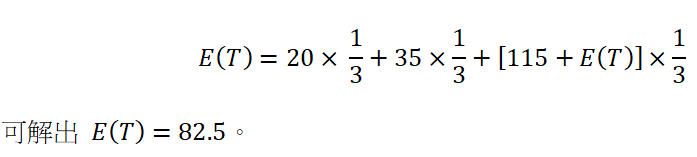
這類題目須要利用雙重期望值定理求算,即先計算給定每個情況下的條件期望值,再針對條件期望值作加權,即可解出離開迷宮所需的時間。令 T 表示離開迷宮所需的時間,根據題目的資訊,若選擇 X 走廊,則花了 20 分鐘後即會離開,因此E(T|X) = 0。若選擇 Y 走廊,則花了 35 分鐘後會離開,因此E(T|Y) = 35。
若選擇 Z 走廊,將會花 115 分鐘後回到原點。假設從原點開始出發,離開的期望時間為E(T),則 E(T|Z) = 115 + E(T),表示浪費 115 分鐘後回到原點,而從原點出發,無論之前的狀況如何,接下來的預期時間為 E(T),因為你無法分辨哪一個走廊是否走過。因此 E(T) 是三種情況的加權平均,選擇各走廊的機率皆為 1/3,故由